
Millions Protest Against Trump in Nationwide "No Kings" Protests.

On Saturday, millions of people nationwide participated in "No Kings" protests against the Trump administration.
"No Kings" rallies have been held to protest policies by President Donald Trump, such as immigration enforcement, the Iran war, and the rising cost of living. Saturday's third round of protests involved more than 3,300 local events, with a "flagship" march in St. Paul, Minnesota, where two people , Renee Good and Alex Pretti were killed by federal officers earlier this year. Protests were backed by about 500 groups with an estimated $3 billion in combined annual revenue. The lead coordinator for the protest was the Indivisible Movement, a Democratic political advocacy organization funded by billionaire George Soros. Arrests were made in Los Angeles, where dozens of protesters, including one with a dagger, refused to disperse.
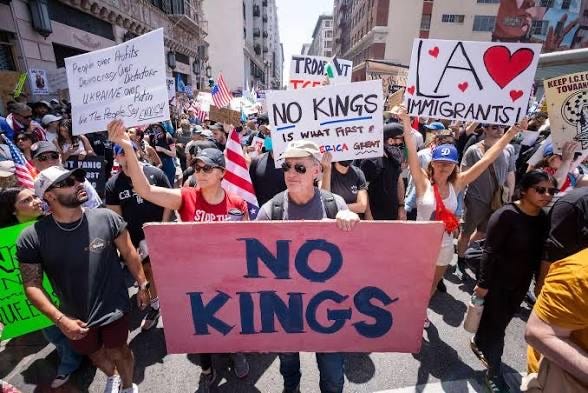
Below are the different report on the matter.
Media Coverage Comparison
From the Left
NBC News: 'No Kings' protests held nationwide, with flagship rally in Minnesota
Link to story: https://www.nbcnews.com/politics/politics-news/no-kings-protests-third-largest-trump-administration-rcna265502
From the Center
BBC News: No Kings protests draw large crowds to rally against Donald Trump
Link to Story: https://www.bbc.com/news/articles/cq8wy7g1gd1o
From the Right
Fox News:500 groups with $3B in revenues are behind the #NoKings protests and communist call for 'revolution'
Link to story: https://www.foxnews.com/us/500-groups-3b-revenues-behind-nokings-protests-communist-call-revolution
PrismwireNews Observations
The nationwide “No Kings” protests represent more than a moment of public dissent they point to a broader shift in political engagement and legitimacy dynamics within the United States.
With demonstrations occurring across thousands of locations, the scale suggests a level of coordination and participation that extends beyond isolated activism. While the immediate focus is opposition to specific policies and leadership decisions, the underlying signal is a growing tension between segments of the public and the direction of governance.
From one perspective, this can be interpreted as a reaffirmation of democratic participation citizens actively engaging in public discourse and exercising their right to protest. From another, it highlights the depth of political polarization, where disagreement is no longer confined to institutions but expressed through large-scale mobilization.
What makes this development particularly notable is not just the size of the protests, but their limited immediate impact on policy direction. This suggests a potential disconnect between public demonstration and governmental response, raising questions about how influence is translated within the current political environment.
For observers, the key issue is not solely the protests themselves, but what they indicate about the relationship between authority and public consent.
Sustained, large scale demonstrations of this kind can shape political narratives, influence future electoral outcomes, and affect how governance is perceived both domestically and internationally